
Adem Jones || Issue 7 || November 4, 2024
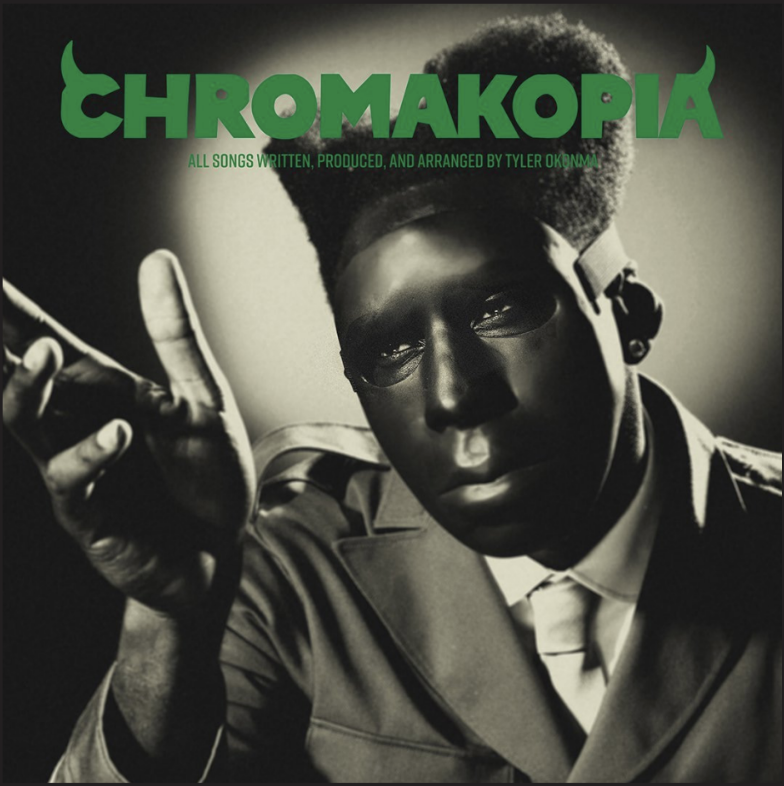
In the realm of hip-hop, few artists can seamlessly blend vulnerability with bravado quite like Tyler, the Creator. With his latest album, Chromakopia, Tyler not only showcases his artistic evolution but also dives deep into the complexities of identity and fame. The journey begins with the music video for “Sorry Not Sorry,” a B-side from Call Me If You Get Lost. Tyler invites us into a theatrical experience, gathering an eclectic cast of friends, family, and former lovers in a cinematic setting. As a soldier leads them to their seats, we are introduced to the transformative character of St. Chroma, which is a representation of Tyler’s inner struggles.
The narrative unfolds dramatically, with Tyler enclosed in glass, where he engages in the act of shedding his past. This culminates in the pivotal moment when he removes the pastel ushanka of Sir Baudelaire, symbolizing the release of old personas that no longer define him. Front and center, Tyler’s mother, Bonita Smith, opens the album with a powerful statement: “You are the light. It’s not on you, it’s in you.” This sentiment reverberates throughout the project, framing Tyler’s introspective exploration of legacy and self.
Musically, Chromakopia is an ambitious endeavor that captures Tyler’s duality. The album opens with “St. Chroma,” which bursts forth with a melodic flute that resembles a battle cry.
Accompanied by driving rhythms, Tyler’s whisper-rap urges listeners to lean in, as he says, “I have something important to share.”
Daniel Caesar’s ethereal vocals bring more life to the track, prompting us to question, “Can you feel that fire?”
The atmosphere shifts, drawing us deeper into Tyler’s psyche.
In tracks like “Noid,” Tyler navigates the depths of his mind, confronting fears that lurk beneath the surface. He reflects on the pressures of fame, revealing feelings of being constantly observed by fans and critics. At 33, Tyler grapples with the reality that while many of his friends are starting families, he is haunted by anxieties about potential break-ins from obsessed admirers. The eerie electric guitars sampled from Zamrock legends Ngozi Family create a chilling mood that resonates throughout the song. It echoes the haunting Swahili warning from Get Out: “Listen to your ancestors. Something bad is coming. Run.”
A consistent voice throughout the album, Tyler’s mother, serves as his moral compass. In the heartfelt track “Like Him,” he questions whether he will follow in the footsteps of his estranged father. Bonita complicates this narrative by sharing, “He’s always wanted to be a father to you… He’s a good guy,” prompting Tyler to reflect on his long-held criticisms of his father’s absence. Coupled with the anxiety of a pregnancy scare in “Hey Jane,” it becomes clear why Tyler is so preoccupied with fatherhood. In “Take Your Mask Off,” he confronts his fears, confessing, “Boy, you selfish as f***, that’s really why you scared of bein’ a parent.” This really highlights the humbling experience of recognizing flaws within one’s self.
Unlike the flashy lifestyle depicted in Call Me If You Get Lost, Chromakopia redefines Blackness as a cultural status symbol.
Tyler weaves themes of white supremacy into his narrative with subtlety and skill. In the track “I Killed You,” he begins with a playful interpolation of “Wheels on the Bus,” but quickly pivots to critique Western beauty standards.
With vibrant percussion reminiscent of a New Orleans parade, he challenges Black listeners to embrace their uniqueness,
boldly proclaiming, “You the room, baby, they the motherf-ing elephant.”
Tyler’s collaborations with several Black women further amplify the joy of music-making as a Black artist in hip-hop. In “Sticky,” featuring GloRilla, Sexyy Red, and Lil Wayne, he confidently says, “Give a f*** ’bout pronouns, I’m that n**** and that b****,” all delivered over an irresistibly catchy beat. The energy of this track is high and exciting, with a hook that’s sure to stick around in the listener’s heads long after the song ends. Tyler’s ability to shine through whimsical beats, as seen in tracks like “Balloon” and “Thought I Was Dead,” reinforces his prowess as a rapper.
For all the introspection that comes with navigating his thirties, it’s the confident tracks like “Thought I Was Dead,” “Rah Tah Tah,” “NOID,” and “Sticky” that resonate the most. Tyler’s disdain and ultimately rejection of his former self hits hard as he raps, “That version of Tyler that you knew was a memory,” anticipating critiques with a dismissive, “Who is that? You n***** get too attached to hear the theory.” Not long ago, his controversial lyrics incited fear and controversy in listeners and in the media, but he has emerged as a more approachable figure without sacrificing the sharp wit that defines him as an artist and a lyricist. Not many artists have his infectious confidence, which he is able to use as a tool for creating discussions rather than flat-out cockiness.
Ultimately, Chromakopia stands as a testament to Tyler’s growth and it is a powerful exploration of identity, vulnerability, and the struggles that come with fame. He emerges as an artist who isn’t afraid to confront his past while celebrating his present, making light of some of the darker portions of his journey. This album is so much more than a collection of songs, it’s a journey through Tyler’s mind, a picture painted using his experiences, fears, and triumphs. As he navigates insecurities and revels in successes, Tyler, the Creator remains a force that captivates, challenges, and inspires.

 The Hudsonian