
What are frescos, and why are they just being found now?
Jonah Flanagan || Issue 7 || November 4, 2024
Recent reports of a small house located in Rome, lacking an atrium but decorated with preserved frescoes has been discovered in the roman city of Pompeii, which was destroyed by Mount Vesuvius in A.D. 79.
Pompeii was a flourishing resort city in the south of Rome, that was built around 8-9th century B.C. by the oscans. But along the coast of the city was the shadow of a volcano called Mount Vesuvius where its famous eruption occurred which devoured the city in ash and rubble in 79 A.D.
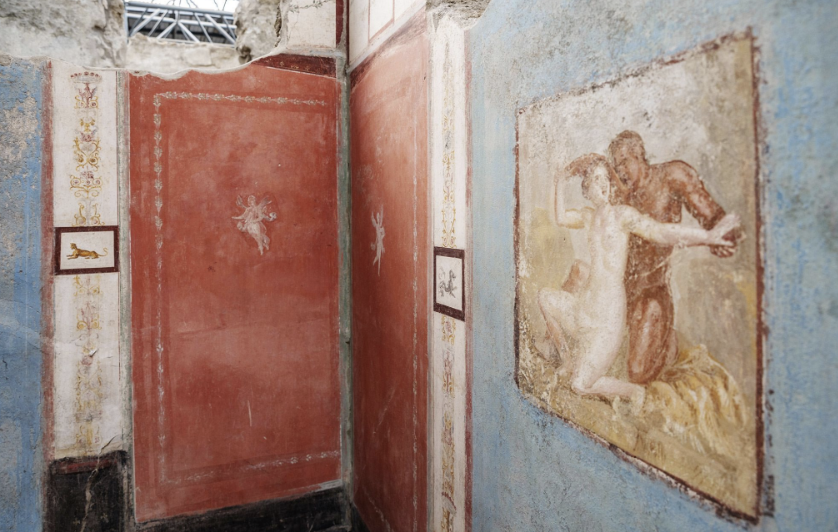
Photo credits: Archaeological Park of Pompeii
Aside from the famous eruption, Pompeii was most known for its buzzing city life, from the artifacts, the cult of Isis, Fashion, and its art. Mostly it’s frescos. Frescos is an art technique that consists of its mural painting, the process would include mixing water and powdered dye pigment with a plaster that would be applied to a wall, which would result in a mural.
The site has been named “The House of Phaedra” after the mythological queen of Athens, who is depicted in one of the paintings with her stepson Hippolytus, who refuses her advances.
On the other walls depicting patterns, scenic views from nature, an encounter between a satyr and a nymph, and gods who may or may not represent Venus and Adonis. Unlike many of the houses excavated at the site, it was not built around the traditional atrium, which is an open space with a pool for collecting rainwater. Despite its small size, the house is stated to “strike us for the high level of its wall decorations,” which means they were of similar quality to much larger and more opulent homes near the discovery, which lies at the center of the site.

 The Hudsonian