
Aisha Mustafa || Staff Writer || Issue 18
In a recent study, scientists were able to examine an asteroid sample on a very small scale. That asteroid is named Bennu and was chosen for several reasons. Bennu is a carbonaceous asteroid, meaning that it is rich in carbon-containing (organic) material. Its orbit is proximal to the earth without actually coming into contact with earth’s atmosphere, allowing it to remain representative of primitive conditions. Thus, it became a prime target for NASA’s OSIRIS-REx mission.
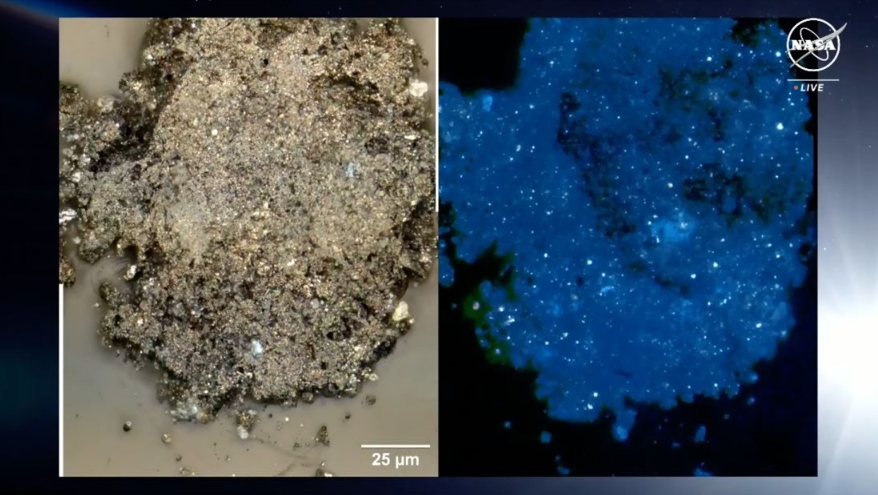
A group of scientists examined a specific sample labeled OREX-80066-3 which was collected by the OSIRIS-REx spacecraft returned in 2023. It has since been carefully sealed and preserved. Historically, spectroscopy has been used in many chemical contexts and especially in astronomy. It is the study of how light interacts with matter, allowing scientists to differentiate between materials based on interactive properties. For example, infrared (IR) spectroscopy uses IR light and examines the vibrational transitions of electrons through excitation, while Raman spectroscopy uses a laser (often in IR or visible light) and examines the inelastic scattering of photons. Information from these methods is useful in identifying the chemical composition of matter.
Nasa
Both of these methods were used in the examination of the Bennu sample except at a nanoscale level. Through this, it was observed that Bennu’s internal chemistry is not uniform (homogeneous). Instead, it consists of distinct alternating regions each with unique properties. Three of these regions were identified, the first of which consists of hydrocarbon aliphatic molecules. This region is expected to be hydrophobic, in contrast to the second region rich in carbonate minerals which would respond more favorably to water. Finally, the third region consists of nitrogen containing organic compounds that are relevant to biologically necessary compounds such as amino acids.
Overall, these findings contribute to a greater understanding of how chemistry developed over time long before the development of more complex systems. They offer more data for future research to build on and enhance the collective understanding of the world that surrounds us.

 The Hudsonian