
A New Era for Federal Labor Policy, Murphy Takes the Helm at the NLRB
Isabelle Holt || Editor-in-Chief || Issue 17
The National Labor Relations Board (NLRB), the federal agency responsible for enforcing labor law and overseeing union elections in the private sector, is entering a significant new phase of leadership. At the center of this shift is James Murphy, a longtime agency insider who has now risen to serve as chair.
Murphy’s appointment follows his confirmation to the board in December 2025 as part of a broader wave of nominees advanced by President Donald Trump. He was officially sworn in on January 7, 2026, helping restore the board’s quorum after nearly a year in which it lacked enough members to fully function.
With more than four decades of experience at the NLRB, Murphy brings deep institutional knowledge to the role. He began his career at the agency in 1974 and has served in multiple legal and advisory positions, including as chief counsel to former chairman Marvin Kaplan. His long tenure has made him a familiar figure within labor law circles, though his elevation also signals a broader ideological shift in how the board may operate moving forward.
The NLRB plays a critical role in American workplaces. Established in 1935, the agency enforces the National Labor Relations Act, protects workers’ rights to organize, and adjudicates disputes between employers and unions. When the board lacks a quorum, it cannot issue decisions, leaving cases unresolved and slowing enforcement of labor protections. That was the reality for much of 2025, when internal and political conflicts left the agency effectively stalled.
Murphy’s leadership comes as the board regains full operational capacity, and as its political balance shifts. His confirmation, alongside fellow Republican appointee Scott Mayer, established a Republican majority on the five member panel. This change is expected to influence the direction of federal labor policy, particularly after several years of more union friendly rulings under the previous administration.
Early signs of that shift are already emerging. With a new majority in place, the board has begun reconsidering policies related to employer liability, union organizing rules, and workplace standards. Supporters of the changes argue they will provide clarity and reduce regulatory burdens for businesses, while critics warn they could weaken protections for workers and unions.
Murphy now steps into the chairmanship at a moment when the NLRB faces both opportunity and scrutiny. The agency is not only working through a backlog of cases but also navigating broader legal and political debates over its authority and independence. Questions about presidential power over independent agencies, and the limits of that authority, continue to shape the environment in which the board operates.
As chair, Murphy’s role will be both administrative and symbolic. While the position does not carry sweeping unilateral power, it does influence the board’s agenda, priorities, and tone. With the NLRB once again able to act, his leadership will help determine how federal labor law is interpreted and enforced in the years ahead.
For workers, employers, and unions alike, the implications are significant. The decisions made under Murphy’s tenure could reshape organizing efforts, workplace rules, and the balance of power between labor and management across the country.
The Political War Will Continue After the 2024 Election
Olivia Henry || Issue 8 || November 12, 2024
The United States presidential election has concluded. Donald Trump is back in office for his second term. Some people are upset, others are joyful, and the neutral part of the population feels no particular way. It has been a year of infighting for the United States as it always is during the presidential election. And though the battle for president is done, the political war will rage on.
For decades, people in the U.S. have found themselves in an endless war of politics. Vote red or vote blue. Democrat or Republican. Far left or far right. You’re either saving the country or destroying it. You must choose a side; neutrality is not an option. This is dangerous rhetoric. Being constantly promoted to the two extremes can leave one feeling everything is black and white with no grey in between. We ironically see freedom of choice trampled over with this two-party system lunacy. There has always been a growing divide in politics, and it never ends no matter how many election cycles we have and no matter who is running for president.
Whether the matter is about elected officials, policies and law, or the justice system, politics is always going to cause an uproar. Because politics is concerned with the governing body over a group of people; someone is always going to have something to say.
Photo credits: The Observer
In the States, everyone has an equal opportunity to be heard. That doesn’t guarantee all requests to be granted, because we live in a nation where every vote counts and in turn the majority rules. But it seems people aren’t satisfied with that, the system that creates the most opportunity for fairness.
The reality is that nobody is going to get everything they want out of government. Somebody is always going to be stepping on someone else’s foot, intentionally or not.
And because of the vicious climate of politics, how it’s worsened over the years, the fighting will not cease.
Trump’s Won- What’s Next?
Elizabeth Star || Issue 8 || November 12, 2024
After nearly two years of campaigning for both parties, the 2024 presidential election is finally over. Although votes are still being counted days later, the election was called for Donald Trump earlier than possibly anyone expected. Nearly every poll and aggregator claimed the election was extremely close — Nate Silver, statistician and founder of poll-aggregation site 538, claimed to have run 80,000 simulations on his forecasting model and found the results to be “literally closer than a coin flip” with Harris having a 50.015% chance to win. Journalists and citizens alike bemoaned a possible repeat of the 2000 election, with drawn-out discourse over the true winner and possible recounts.
Nevertheless, the results were clear—and they were as surprising as they were devastating to Democrats.
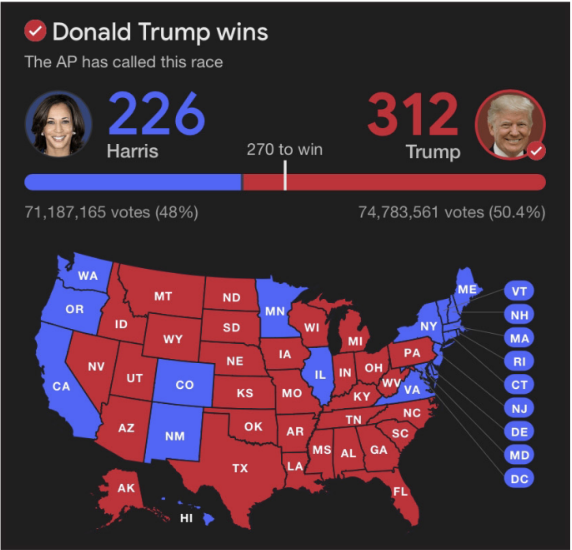
Not only did Trump win the electoral college, including all of the “tipping point” swing states (Wisconsin, Michigan, Pennsylvania, North Carolina, and Georgia), but he beat the odds and took the popular vote as well.
Furthermore, nearly every state had a noticeable shift towards the Republican Party in its voter results, with California and New York holding the strongest shift at 12%.
No bones about it — it was a blowout, the belated “red wave” that conservatives had promised in 2022.
Both candidates made unique speeches Wednesday touching on their top issues.
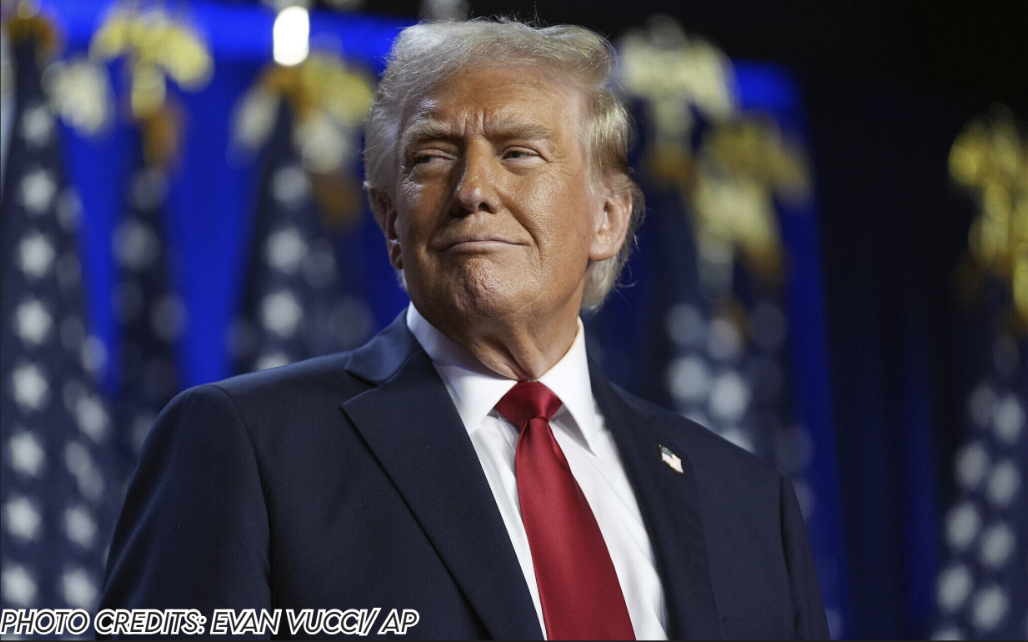
Kamala Harris’ speech focused on the future of American democracy, which was the top polled voting issue for Democrats this election. Harris was sure to point out that “A fundamental principle of American democracy is that when we lose an election, we accept the results.” This is no doubt referring to the attack on the Capitol in 2021 spurred on by Trump’s insistence that the 2020 election had been stolen. Though she conceded that America may well be “entering a dark time”, Harris reassured voters that “the light of America’s promise” would endure.
Trump’s speech started out a bit differently. “We have a country that needs help, and it needs help very badly,” Trump said at a rally in Florida Wednesday morning. “We’re going to fix our borders, we’re going to fix everything about our country.” The language leaned towards an image of an America that had been thoroughly broken, and had even been taken over by foreign, un-American entities: “This will forever be remembered as the day the American people regained control of their country.” Although Trump claimed “It’s time to put the divisions of the past four years behind us,” he may not have been referring to anyone on the left at all–in the same speech, he praised Vice President elect JD Vance for voyaging “into the enemy camp” for Vance’s interviews on CNN and MSNBC.
It’s hard to reconcile a supposed message of unity with this and Trump’s vague, often ominous promise to purge “the enemy from within”. So, what’s next for America in 2025? The most talked-about potential policy change this week is Trump’s proposed tariffs on all foreign goods. The current plan is to place tariffs up to 60% on goods imported from China, and a universal tariff of 10% or more on all other imports. Though tariffs are meant to encourage consumers to buy products made in their home country, America has offloaded so much of its manufacturing that consumers may just have to deal with the increased prices.
Many American manufacturers also use parts and materials imported from other countries, so even domestic products will likely see a price increase. Even those who voted for Trump are reportedly feeling uneasy about what this means for their personal finances. While the economy was the issue that likely pushed Trump over the top in this election, many liberals are more concerned with “Project 2025” a game plan written by some of those closest to Trump’s administra-tion that could prove devastating to social and economic progr-essivism in the United States. Among the proposed policies are a move towards a national ban on abortion, legislation aimed at restricting birth control options, cutting environmental regulations drastically, removing legal protections for all LGBT+ people, dis-mantling federal programs like Medi-care and Medicaid, and even getting rid of the Department of Ed-ucation altogether. The plan could cripple the working class by destroying America’s social safety net, and make the country an extremely dangerous place for women and minorities. And jud-ging from Google search result trends, with “what is Project 2025” spiking after Trump’s election, many voters were not informed that this plan even existed. Ultimately, as with every new administration, we’ll have to wait and see which campaign promises are fulfilled, and which were made to be broken.
U.S. to Prohibit Chinese AI Investment: U.S. Moves to Ban Chinese Investment in AI to Protect National Security
Christian Rasmussen || Issue 6 || October 28, 2024
The United States of America has made a powerful yet dangerous move against China, by potentially banning the investments of AI technology with China and Chinese companies. This move by the Biden Administration was to hopefully protect the people from inadvertently aiding the Chinese military by investing in Chinese companies.
According to Treasury official Laura Black, they will try to pass this bill signed by Joe Biden before the election hits. It is a seemingly final move from Joe Biden before the power of the presidency is exchanged from him to the eventual winner of the Presidential election taking place this November.
The investment in Chinese AI equipment is seen as dangerous in the eyes of the American government, because it may give the Chinese a technological advantage over the United States. The United States likes to be able to maintain that power stance over nations to have leverage in the god-forbidden event when things go awry between nations.
Photo Credits: REUTERS/Dado
Ruvic/Illustration/File Photo

There were a few exceptions to the rule being put in place against Chinese AI Companies, such as trading “index funds or mutual funds, certain limited partnership investments, and certain syndicated debt financings.” The regulation of trading with Chinese semiconductors and microelectronics was put in place to supposedly protect America and its people from investing in companies with unsure intentions.
A Department spokesperson for the U.S. Treasury Department has declined to comment on the matter, leaving officials confused as to what may be behind this move from the Biden Administration.
 The Hudsonian