
Adem Jones || Issue 13 || February 19, 2025
There’s something about watching beauty fade in real time that makes people squirm. Not just in a personal way, but in a collective, cultural way. Hollywood is built on the illusion that youth is infinite, that desirability equals existence, and that once a woman stops being either of those things, she stops being anything at all. “The Substance” takes that idea, pulls it apart piece by piece, and forces us to sit with the wreckage. Elisabeth Sparkle (Demi Moore) is a woman who has spent her life being seen, until suddenly, she isn’t. She isn’t young anymore, and in this world, that means she isn’t relevant. After a chain of events, Elisabeth finds herself introduced to “The Substance,” and it doesn’t take long for her to or
der. That’s where Sue (Margaret Qualley) comes in. Sue is the new, improved version of Elisabeth. The younger, shinier model. But Sue isn’t a person. She’s a concept, and the creators of the substance emphasize the harsh truth, Elisabeth and Sue are one. What’s most unsettling about Sue isn’t just that she replaces Elisabeth; it’s that she does it so easily. Sue has no last name, no history, no depth. And yet, she rises to unimaginable success, adored and consumed by an industry that never questions where she came from.
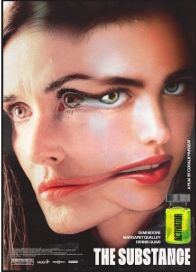
The most heart-breaking moment in The Substance for me comes when Elisabeth stands in front of the mirror, getting ready for a date with a man who sees her, really sees her, as she is, and finds her beautiful. For a moment, there’s hope. Maybe she can believe it too. But every time she moves toward the door, she catches a
glimpse of Sue’s billboard outside, that impossibly ageless face staring back at her, daring her to measure up. So, she turns back to the mirror, adjusting. A little more makeup. A higher neckline. Cover the hands. More powder. Fix the hair. But it’s never enough. She wipes it all off and starts over, faster, rougher, until she’s clawing at her face, smearing the foundation into something unrecognizable, rage, grief, desperation, all of it collapsing in on
itself. It’s the most honest moment in the film because so many people have been there in some way, standing in front of a mirror, trying to be something better, younger, more palatable. And in the end, Elisabeth doesn’t leave. She never even gets out the door. The body horror is relentless, grotesque, and exactly what it needs to be. The transformation is not just physical but existential. This is what happens when you reject aging, when you buy into the lie that you can stay young forever. It turns you into something unrecognizable. The film doesn’t shy away from the ugliness of it, the desperation, the self-destruction, the way the pursuit of perfection consumes everything in its path. And then there’s the ending. After everything, after the blood and the madness, Elisabeth, Sue, Monstro Elisa Sue, or what’s left of her, steps back into the light. She has no illusions anymore. She knows what the world sees when they look at her, and she doesn’t
care. The audience, both in the film and in real life, is forced to confront their own role in this. The way we consume beauty. The way we discard women once they no longer fit the image we’ve projected onto them. It’s ugly. It’s uncomfortable. And it’s brilliant. “The Substance” isn’t subtle, but it doesn’t need to be. It holds up a mirror, and whether we like what we see or not, it doesn’t look away.

 The Hudsonian